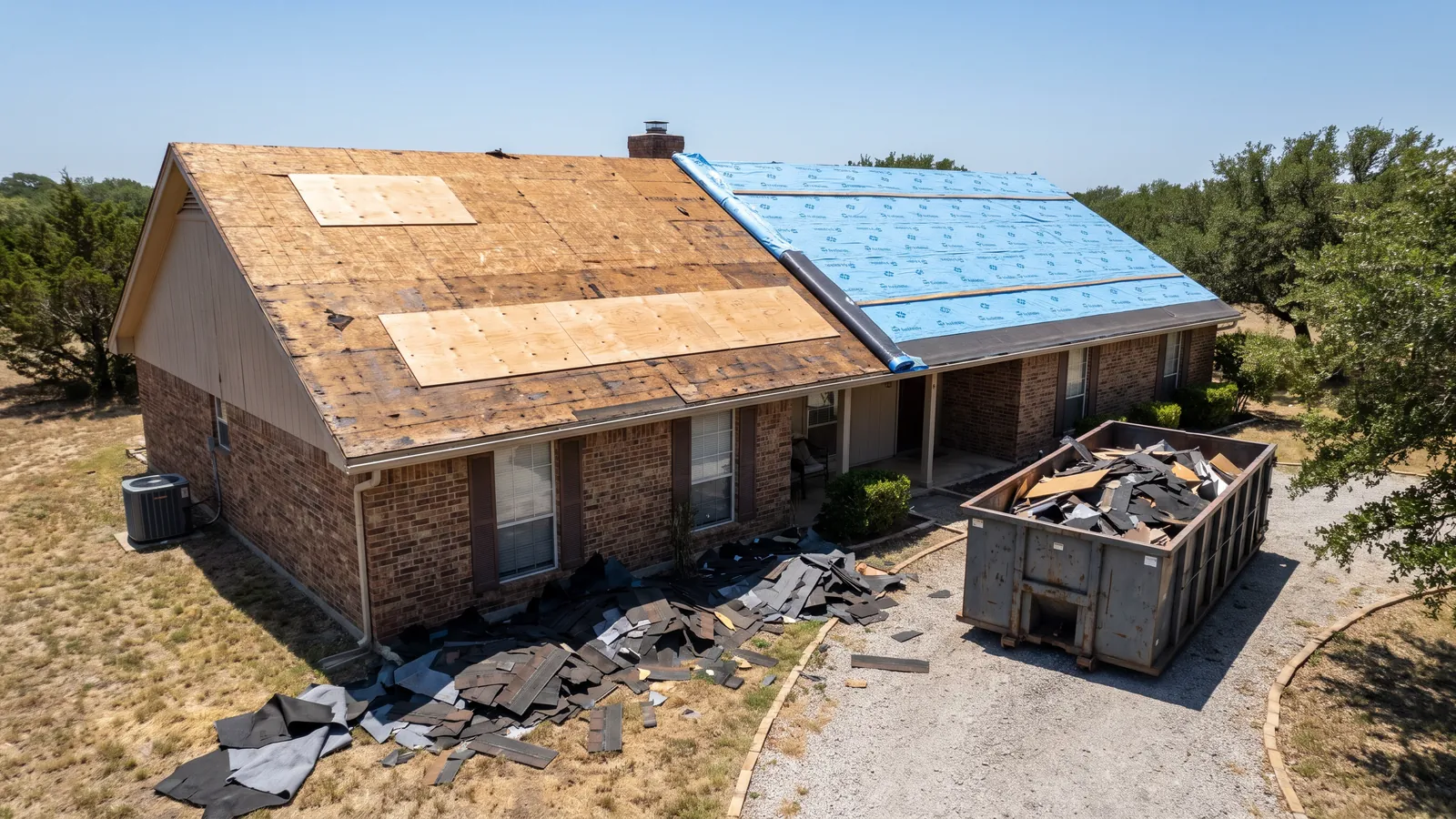
Every figure below is a planning range for Travis, Williamson and Hays counties, built around a complete replacement: tear-off to the deck, decking repairs, new underlayment and flashing, the new roof installed to its manufacturer's specification, disposal and cleanup. It is not a quote. The quote is the itemized sheet written after a free inspection, good for 30 days. A number quoted from the street without anyone on the roof or in the attic is a guess with a company name on it.
2026 planning ranges
| Item | Range | What moves it |
|---|---|---|
| Architectural shingles, installed, per square | $450 – $650 | Pitch, stories, layers to remove, waste on cut-up roofs |
| Class 4 impact-resistant shingles, per square | $500 – $720 | Brand; usually offsets a premium discount |
| Standing-seam metal, per square | $1,100 – $1,800 | Gauge, Kynar finish, profile, trim count |
| Exposed-fastener metal panels, per square | $650 – $1,000 | Gauge; deck or purlins |
| Typical 25- to 35-square home, shingles | $11,000 – $23,000 | Complexity; decking; ventilation |
| Typical home, Class 4 shingles | $12,500 – $25,000 | Same drivers |
| Typical home, standing seam | $28,000 – $58,000 | Complexity and trim dominate |
| Decking replaced | $95 – $160 per sheet | Found at tear-off; a 1990s roof often needs 3 to 10 sheets |
| Steep pitch (8/12 and up) or two-story | +10% – 20% | Staging, tie-offs, time |
| Second layer of old shingles removed | +$50 – $90 per square | Labor and disposal |
| Skylight replaced during the job | $900 – $2,200 | Size; deck-mount or curb |
| Chimney cricket and new flashing | $500 – $1,400 | Masonry work |
| Ridge vent, intake vents, drip edge, boots, underlayment | Included | Part of the system |
| City of Austin permit, WUI zones only | $250 – $600 | Own line; suburbs set their own fees |
| Disposal and cleanup with magnetic sweep | Included | Dumpster on the drive for a day |
How many squares is my house?
Footprint is not roof area. A 2,200-square-foot single-story house with a 6/12 pitch and two-foot overhangs has roughly 28 to 30 squares of roof; a two-story house of the same floor area has about half that footprint and perhaps 17 to 20 squares, but steeper and higher, so the per-square price rises. Cut-up roofs with many hips, valleys and dormers waste more shingle and take more labor than a simple gable of the same area. The inspection measures it; satellite measurement tools get within a few percent and are fine for budgeting.
What moves the total
Decking. The one line nobody can see until tear-off. Austin roofs from the 1990s on are mostly OSB, which swells and delaminates where a leak has been; three to ten sheets is normal on a twenty-year roof and it is priced per sheet, not padded into the total. Pitch and height. Walkable 4/12 and 6/12 roofs are the base; 8/12 and above need staging, and two-story work takes longer. Complexity. Every valley, hip, dormer and penetration adds cutting, flashing and waste. Material. Class 4 adds roughly ten percent over standard architectural shingles; standing seam more than doubles the shingle figure. The WUI. Inside Austin's wildfire zones a replacement needs a permit, a Class A assembly and metal-flashed valleys; shingle roofs over the right underlayment qualify, so the cost is mostly the permit and the valley metal. Ventilation. A roof that needs intake vents cut or a ridge vent added gets them, because a baked attic shortens the new roof's life.
What should not be on the quote
A charge for the inspection. A second layer over the old roof. A deductible discount of any kind, which is illegal under Business and Commerce Code 27.02. A vague line for "miscellaneous" that absorbs the decking. And a price with no manufacturer, product line, rating and warranty term named, because then you cannot check that what goes on the roof is what you paid for.
Paying for it
After hail or wind, most policies pay replacement cost less depreciation up front and the depreciation after completion, with your deductible always yours. For a roof replaced for age, the contractors can offer third-party financing with fixed payments, and Class 4 or metal earns a premium discount at the next renewal. Paying for a roof walks through all of it.
Questions on this
Why do three quotes for the same roof differ by $6,000?
Usually because they are not for the same roof. One includes decking by the sheet, new flashing and a ridge vent; another assumes the decking is perfect and reuses the flashing; a third is a second layer over the old shingles. Compare the line items, the product named and the warranty term, not the total.
Is a cheaper three-tab shingle still available?
Barely, and not worth it. Three-tab shingles last fifteen to twenty years here, carry a lower wind rating and offer no impact rating. The saving over architectural shingles is a few hundred dollars on a house.
How much does the Class 4 discount save?
It depends on the carrier and the policy; many Texas homeowners see a meaningful cut to the wind-and-hail premium, which over a few years often repays the Class 4 upgrade. Get the figure from your agent in writing before choosing, and ask whether a cosmetic exclusion comes with it.
Does the price include the permit?
Where one applies, yes, as its own line. Inside Austin's WUI zones a replacement needs a City permit; elsewhere in Austin a shingle-for-shingle job is exempt. Round Rock, Cedar Park, Pflugerville, Leander, Lakeway, Bee Cave, Dripping Springs and Buda set their own requirements and fees.
When is the cheapest time to reroof in Austin?
Late fall through winter, after the hail season and before the next one, when crews are less stretched and material prices are steadier. A roof at the end of its life should not wait for the season, though; a spring storm on a bald roof is a wet living room.
Read next: Roof replacement · Metal roof cost · Class 4 shingle roofs · Paying for a roof