The storm
Note the date. The National Weather Service storm reports record hail size and location, and your claim will carry that date of loss.
The inspection
A roofer documents the roof: test squares per slope, strike counts, scale photographs, dents in the soft metals. Free, and the photographs are yours.
The decision
Yours. Does the damage meet a carrier's threshold, and does the repair exceed your deductible by enough to be worth a claim on your record?
Filing and the adjuster
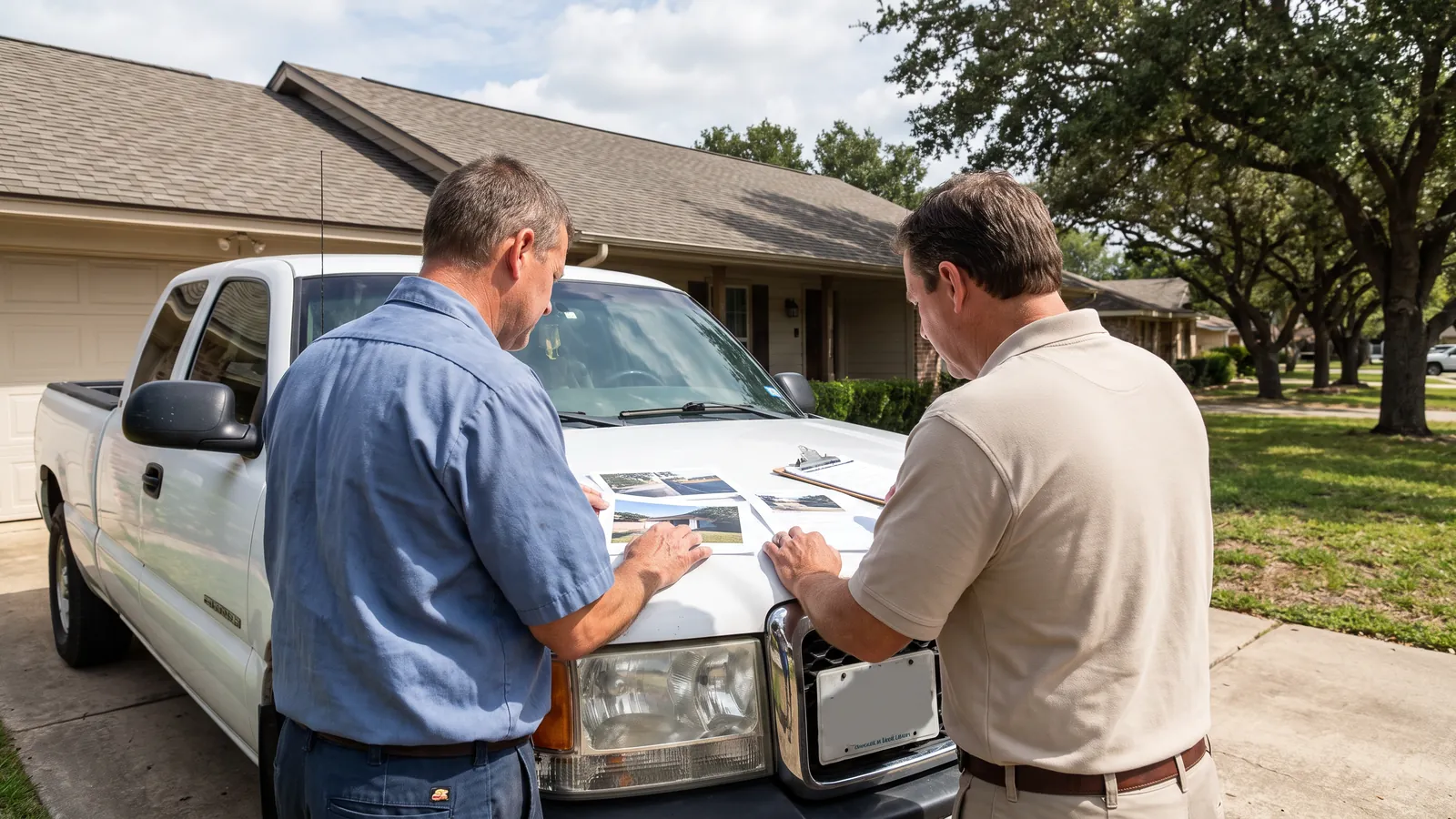
You notify your carrier. An adjuster inspects, and the roofer can be there to walk the roof and point out what was found.
The first payment
Actual cash value: replacement cost less depreciation for the roof's age, less your deductible. The scope lists what the carrier will pay for.
The work
The roof is replaced to the agreed scope, with any upgrades you choose paid by you. The roofer invoices and photographs the finished roof.
The second payment
Recoverable depreciation, released when the carrier receives the invoice and, often, proof that you paid your deductible.
Afterward
Send the Class 4 certificate to your agent for the premium discount. Keep the photographs and invoice with the house papers.
The deductible
Most Central Texas policies now carry a wind-and-hail deductible of one or two percent of the dwelling coverage rather than a flat amount. On a house insured for $500,000 that is $5,000 or $10,000, which means a hail repair under that figure is not worth filing and a replacement is. Under Texas Business and Commerce Code section 27.02, strengthened by House Bill 2102 in 2019, no contractor may pay, waive, rebate or offset that deductible, in cash, by discount or by padding the invoice, and the offense is a Class B misdemeanor. Your carrier may require reasonable proof that you paid it before releasing the recoverable depreciation. A roofer who offers a free roof is offering you a crime and a withheld payment.
What a roofer may and may not do
Texas Insurance Code section 4102.163, from House Bill 1183 in 2013, says a roofing contractor may not act as a public adjuster, or advertise that it adjusts claims, for any property it is roofing or may roof, even if the company holds an adjuster's license. So the roofer here documents your damage, gives you an itemized estimate you may hand to your carrier, meets the adjuster at your house and answers technical questions, and does the work. The roofer does not file the claim, call your carrier about coverage, negotiate the scope or settle anything. If a claim is disputed, Texas licenses public adjusters, who represent you for a percentage of the settlement, and the Texas Department of Insurance takes complaints about carriers. Neither is something a roofer may arrange for you.
What the adjuster is looking for
Consistent, random, round impact marks on the shingles, with granules displaced and the mat bruised or fractured, at a count per 10-by-10 test square that meets the carrier's replacement threshold, often around eight or more per square but varying by carrier. Collateral evidence confirming the hail size and direction: dents in gutters, downspouts, vent caps and the air-conditioner's fins, splatter on fences and painted surfaces. And a date that matches a recorded storm. The roofer's photographs are organized exactly that way so the adjuster and the homeowner are looking at the same evidence.
Scope, supplements and code items
The carrier's scope lists what it will pay to replace. If it omits something the roof needs, such as new flashing, a cricket, decking or a code-required item, the roofer's photographs and measurements of the omission are yours to submit as a supplement. In Austin, a roof inside the Wildland-Urban Interface zones where half or more is damaged must be replaced in full as a Class A assembly under a permit; with ordinance-and-law coverage that code-required upgrade is generally covered up to the limit, and the roofer documents the requirement so you can claim it. Upgrades you choose beyond the scope, such as Class 4 shingles when the old roof was standard or metal in place of shingles, are paid by you.
Deadlines
Policies set their own notice requirements, and many Texas policies require that a claim be reported within one year of the date of loss; some are shorter. Prompt notice is always better, and so is an inspection soon after the storm, because bruised shingles lose their granules over the following months and age makes the damage harder to attribute. The hail damage page covers the inspection itself and the hail log lists the recent storms by date.
Questions on this
Should I file a claim for any hail at all?
No. If the damage is under or near your deductible, you pay for a claim on your record and gain nothing. The inspection gives you the strike count and a repair figure so you can judge; the decision stays yours.
Can the roofer meet the adjuster without me?
The roofer can be on the roof with the adjuster and point out what the inspection found, yes. You should still be the one who talks to the carrier about coverage and scope, because that part is yours by law.
What is recoverable depreciation?
The part of the replacement cost the carrier holds back until the work is done. The first check is the depreciated value less your deductible; the second, after the invoice, makes up the difference to full replacement cost on a replacement-cost policy.
My roof is metal and the adjuster said the dents are cosmetic. What now?
Many Texas policies exclude cosmetic damage on metal roofs, so dents in the panel field may not be covered, while crushed seams, split caps or cracked fastener boots are functional damage and usually are. The roofer's photographs separate the two; you decide whether to dispute, with a public adjuster if you want help.
Can a roofer file the claim for me if I sign something?
No. Texas Insurance Code 4102.163 bars a roofer from acting as your adjuster whatever paperwork is signed, and an assignment of benefits does not change that. Be wary of any form that gives a roofer authority over your claim.
Read next: Insurance claim documentation · Hail and storm damage · Austin hail log · Paying for a roof